
Hard To Kill
Masih Alinejad celebrates life. And her would-be assassins are sentenced.

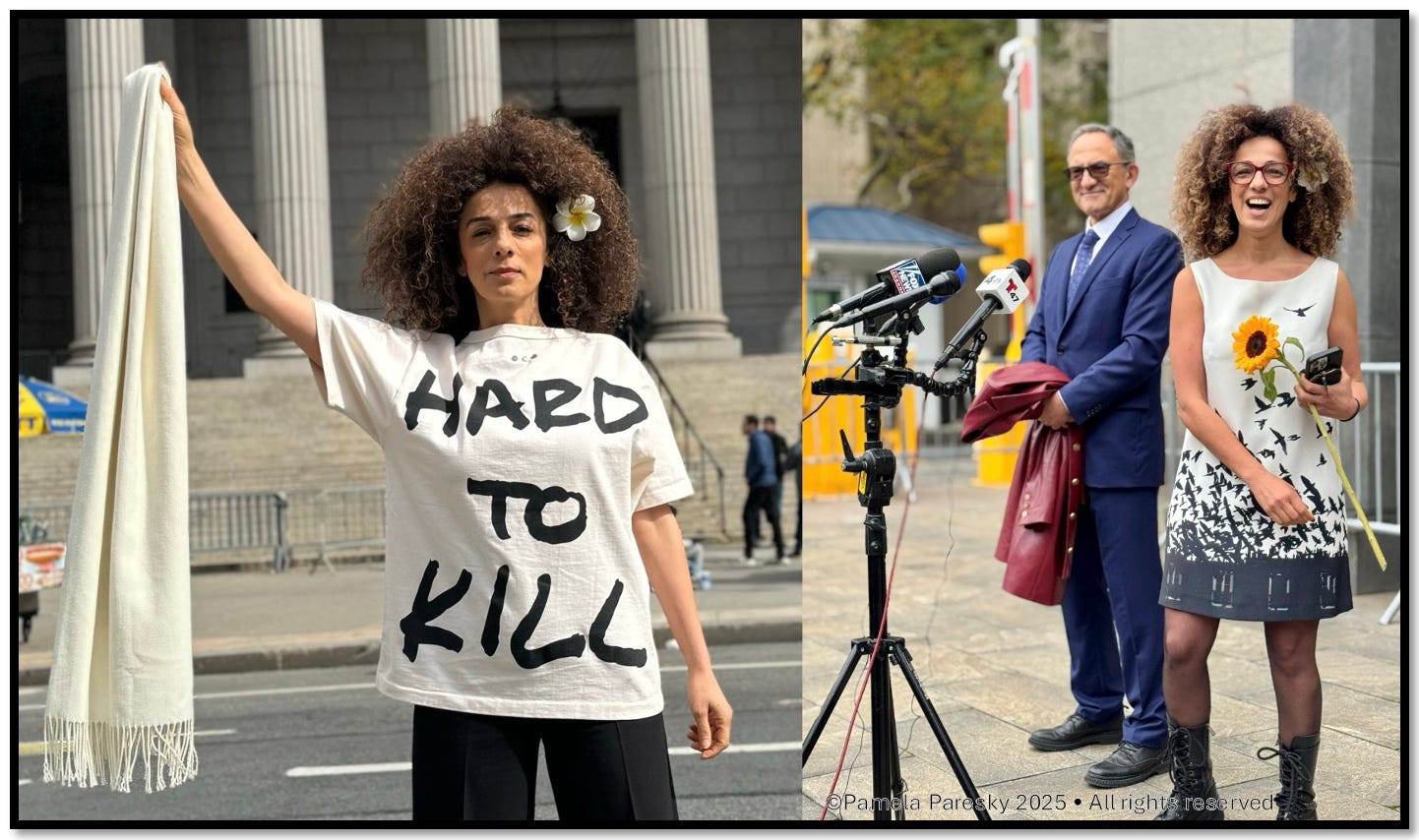
On Wednesday, October 29, Masih Alinejad faced two Russian mobsters at their sentencing hearing. Holding a prepared speech (which she didn’t deliver), she spoke from the heart about what their attempts on her life have taken from her and her family.
“When I came to America,” Alinejad told the judge, “I said, ‘finally, I am safe.’” Instead, she and her husband, Kambiz Foroohar, had to sell their home in Brooklyn—a home with a garden in which Alinejad planted trees named for the family members she hasn’t seen in 15 years.
For her safety, they have been forced to move 21 times.
Alinejad is an Iranian-American journalist, author, and women’s rights activist. She is known for her vocal criticism of the repressive Islamic Republic that violently conquered Iran in 1979, instituting “gender apartheid” and other forms of repression.
She fled Iran in 2009 and has since lived in exile in the U.S., creating social media campaigns such as “My Stealthy Freedom” to document Iranian women’s expressions of dissent under a brutally repressive Islamic regime.
Alinejad’s criticism of the Islamic Republic of Iran has made her a persistent target of a regime that views her activism, which highlights their suppression of women’s rights and intolerance of dissent, as a threat to its authority and control. With reportedly more followers on social media than all of the Ayatollahs combined, her voice resonates so powerfully that the regime has made it a crime to send videos to her—punishable by up to 10 years in prison.
According to U.S. prosecutors, in 2021, the regime conspired to kidnap Alinejad from her Brooklyn home, take her by boat to Venezuela, and from there, bring her to Iran. When that failed, the Islamic Revolutionary Guard Corps (IRGC) turned to two Russian mobsters, Rafat Amirov (aka Farkhaddin Mirzoev) and Polad Omarov (aka Araz Aliyev), promising $500,000 for her murder.
In July 2022, Amirov relayed Alinejad’s location and surveillance details, supplied directly by IRGC officials, to Omarov, who passed them to an Azerbaijani criminal associate, Khalid Mehdiyev, living in Yonkers. Mehdiyev began stalking Alinejad’s Brooklyn home, sending photos and videos back through the chain to Iran.
Funded with $30,000 in cash, he purchased an AK-47-style rifle, magazines, and 66 rounds of ammunition—his “war machine,” as he called it—to carry out the assassination. On July 28, 2022, after days of reconnaissance and real-time messaging with his handlers, Mehdiyev sat outside her home with the loaded rifle, reporting to his crime bosses, “we are ready.”
Shortly thereafter, police stopped his car, discovered the weapon, ammunition, cash, and a ski mask, and arrested him. He confessed. Amirov and Omarov were eventually convicted on five counts—including murder-for-hire, attempted murder in aid of racketeering, and firearm possession in connection with the crime. After their arrest, Alinejad & Foroohar learned that the conspirators had even contemplated burning down the house—when his children had lived there with them.
On Wednesday, Foroohar and Alinejad faced the Russian mobsters. Before the victims delivered their statements, one of Omarov’s lawyers reminded the judge that “nobody died,” and one of Amirov’s lawyers argued that “far from being injured, [Alinejad] has only gotten stronger,” describing the crime as a “murder for hire that did not result in harm.”
Those shocking statements weren’t missed by Alinejad, who described the way the lawyers treated her life as “a transaction.” According to that calculation, Alinejad told the court, “she isn’t dead,” so, there’s no harm.
But the harm has been incalculable. Both Alinejad and Foroohar spoke of constant fear and hyper-vigilance. “Stray footsteps behind us can trigger a surge of panic,” Foroohar admitted.
“The greatest harm,” he told the court, “has been to our relationship with our children, both teenagers. We were forced to explain why an assassin circled our home and what that meant for our family. We lived apart from them for their safety; they could not visit or stay with us. We missed school events, soccer games, and birthdays—the ordinary, irreplaceable moments that make a family whole. That time cannot be restored.”
“I survived the plot,” Alinejad said with a trembling voice, “but the guilt…” She continues to feel responsible for the suffering inflicted on her husband and the children, she said.
The attempted murder “was part of a broader campaign of foreign-directed coercion,” Foroohar emphasized to the court. “Polad Omarov and Rafat Amirov were complicit partners in a pariah state’s attack on an American citizen on American soil—an attack that targeted not only my wife but, in a very real sense, the American way of life.”
The mobsters, both in their 40s, were each handed a sentence of 25 years in prison, 30 years less than the prosecution’s request. “Fairness augers for a greater sentence,”the judge noted, to send a clear message to both criminal gangs and foreign governments. So she sentenced at the statutory maximum for each count. (Unbelievably, the statutory maximum sentence for murder-for-hire is only 10 years when nobody is killed—even when the entity hiring is the government of a foreign country.)
Outside the courthouse, Alinejad and Foroohar celebrated. Holding sunflower, Alinejad told a bank of reporters, “right now [as] I’m talking to you, women [in Iran] are in prison.” She spoke of women being barred from stages in Iran, prohibited from singing. And proceeded to sing in Farsi:
I will blossom through my wounds
Because I am a woman.
I am a woman.
I am a woman.
More to come…